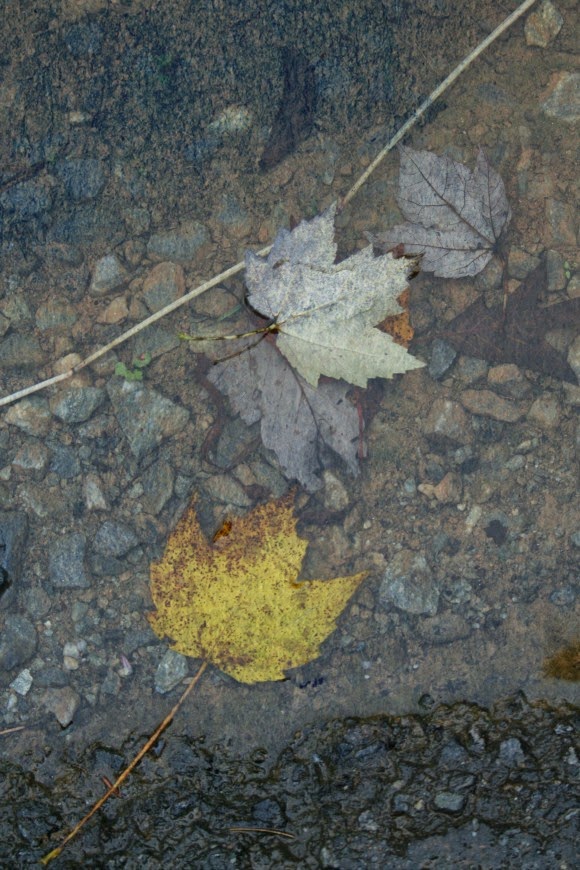
It’s been rainy here in southern Virginia for over a week, but that didn’t stop me from taking my camera outside on Saturday to take some photos of fall leaves. All of the leaves are turning colors now, slowly fading into their fall glory before tumbling to the ground in puffs of wind. Even the butterfly bush it turning yellow, something it rarely does. The viburnum offers scarlet in the island bed; the under story trees, especially the sumacs, are turning vibrant red, purple and mulberry hues.
Why do leaves change color in the fall? It’s the fading chlorophyll that does it. Inside each leaf is a mini food factory. As sunlight touches the surface of the leaves, chloroplasts inside the cells transform sunlight into carbohydrates through the process of photosynthesis.
But in deciduous trees, that process begins shutting down in the autumn. It’s triggered by two things: shorter daylight hours and cooler night temperatures. Both act as signals to the factories to decrease production of carbohydrates. Chlorophyll, which is a bright green color, lessens. With less chlorophyll in the leaves, the underlying colors can now shine forth. Bright yellow for the tulip trees dotting my farm; golden yellow, ochre and saffron for the maples and beeches; scarlet and mulberry for the under story trees.
Why are oaks brown? Some sources say that for oaks, the tannins and/or waste products left in the leaves turn them russet brown. There’s one huge oak tree on my neighbor’s property, however, that turns brilliant red. It’s the first oak in the neighborhood to turn, and we use it as a bellwether for the remaining fall foliage. When Grandpa Oak, as we like to call large, stately oak trees, turns colors, the foliage in the mountains is at its peak, and it’s time for us to go hiking again.
As a child growing up in an urban environment, fall leaves meant a neatly raked pile on the front lawn. In our town, we could also rake the leaves into the gutter. The town had a giant machine with a huge suction hose, like a big vacuum cleaner, that trundled down one side of the street and up the other, neatly sucking up all those glorious fall leaves. And the leaves were glorious! My section of town features mature oaks, maples and my favorite — sycamores. I think sycamores are an acquired taste. If you’ve never seen a sycamore, they make the most glorious shade trees ever, arching over the street to create tunnels of dappled light. They are, however, the messiest trees around, which is why towns no longer plant them. Not only do they shed copious quantities of leaves in the fall, but their seed pods (which we kids nicknamed “itchy balls” and swore that if smashed under the collar of another kid’s shirt would render the victim helplessly itchy) make a big mess. And the bark! Sycamores shed their bark in great peeling masses. Again, as kids we loved it. We’d take the big slices of bark and float them along the gutter currents after a heavy rain, making boats out of them. We’d pretend to be Indians writing upon scrolls of bark. But I’m sure our parents and the town cleanup crew cursed the planners in our neighborhood who planted endless rows of sycamores along Marshall Avenue.
Most of those sycamores were lost in the tornado in the 1980s, replanted with boring old oaks and other typical street trees. But I will never forget their golden green beauty. It was like riding your bike through an underwater tunnel when they leafed out in May, and the colors in the fall were spectacular.
 |
| Our driveway in Virginia with its carpet of leaves just beginning… |
What a beautiful place you have for all the colors of leaves. Enjoy!!!