I spent last Saturday morning getting rid of Eastern tent caterpillars from the apple and pear trees in the orchard here on the farm.
Malacosoma americanum, the Eastern tent caterpillar, is a regular visitor each spring. We first spot the shimmery webs on a clear spring day. The small ‘tents’ built by the caterpillars quickly balloon seemingly overnight into huge bags filled with squirming black caterpillars. Soon, all of the leaves are stripped from the branch nearest the tent. Over time, other branches are stripped, until the caterpillars turn into small brown moths and continue the lifecycle.
Here’s what you need to know about these pernicious pests, how to get rid of tent caterpillars using organic methods, and more.
Identification of the Eastern Tent Caterpillar
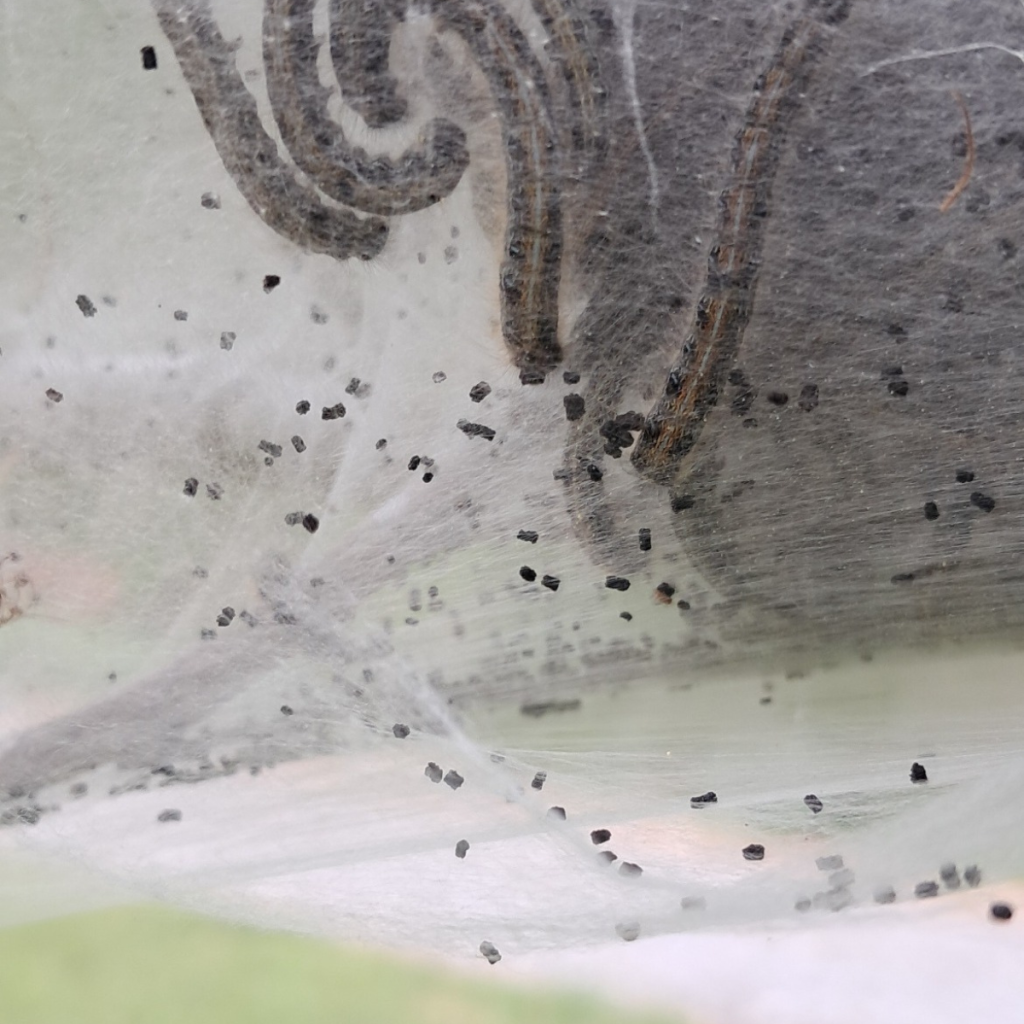
You’ll probably spot their tents first. The Eastern tent caterpillar builds a silken web in the crotch of a tree branch. Inside the web is a mass of black caterpillars. The web provides a home for the insects, protecting them from predators such as birds and providing a warm, snug retreat.
The insects emerge through a small hole in the silk each evening. They crawl along the branch, finding juicy, fresh foliage to eat. Once they stuff themselves with spring leaves, they return to their silken home before dawn. That’s why you don’t usually see them on the branch itself, but rather observe their tents.
Lifecycle of the Eastern Tent Caterpillar
Adult moths lay eggs around the branches of a host tree in the fall. The eggs overwinter and hatch in the spring, around the time that the buds emerge on the tree. The caterpillars spin the tent and emerge at night to feed, returning to the tent when not feeding. One clump of eggs may form one tent, or, according to the University of Wisconsin-Madison, several egg clumps, once hatched, may join to create a massive tent.
Once the feeding frenzy is over, the mature caterpillars separate from the colony. Each spins its own cocoon where it resides for three weeks until emerging as a moth. The adult moth then repeats the lifecycle.
Trees Affected by the Tent Caterpillar
Tent caterpillars seem to love fruit trees, especially apple, cherry, and plum trees, but we have also found them on pear trees. The pictures that accompany this article were taken in my yard on a pear tree. The apples and the wild cherry trees lining the roadways here in central Virginia seem to be the most attractive to these pests.
The problem isn’t that the caterpillars kill the trees through their feeding. Instead, they weaken them by eating the tree’s leaves, stripping branches bare. This decreases the amount of surface area for photosynthesis; the fewer leaves a tree has, the less opportunity it has for making its own food. It’s more of a problem on a small or young tree. They won’t kill mature trees, but they will make them look less attractive.
How to Get Rid of Tent Caterpillars Easily
Here’s how to get rid of tent caterpillars easily and quickly. This is going to gross some of you out, but so be it. I remove them by hand. I put on a heavy pair of gloves, bring out a long-handled rake, and get to work.
If a helper is available (like my husband), he pulls the branch down as low as it can go so I can reach the tent. I use a trowel and open the tent. Next, I put a bucket underneath and scoop the caterpillars out with the trowel. They are then squished in the bucket and bumped in the woods here on the farm.
Sometimes the tents are high up in the apple trees and not easily reached. We use our long-handled pruning saw to open the tent and scoop the caterpillars out. The same process follows, only it’s usually me with a flat-based hoe stomping them in the grass.
I wouldn’t spray for them, although the previously cited university website lists some sprays you can use. Why add potential toxins to the environment for a nuisance pest like this? Instead, put on gloves and get to work. After you get over the ick factor, it gets easier.