Part of the fun of organic gardening is getting to know your neighbors – beneficial insects. Because organic gardening practices include the use of natural methods to control problems and boost soil fertility, insects love organic gardens.
Beneficial Insects and Organic Gardening
Most of the time, beneficial insects visit my garden. Today I took some pictures of beneficial insects out in the vegetable garden and in the little cottage garden next to the shed. The praying mantis has been frightening me on the porch every day. He lurks on the door frame or right over your head as you step onto the porch. Then he turns his head and fixes you with a beady eye, moving his ‘praying’ hands as if clapping. I don’t know whether he’s cheering me on or being sarcastic that I’m out walking the dog again. I give him a wider berth.
Let me introduce you to the beneficial insects I met in my organic garden and around Seven Oaks….
Garden Spider (Argiope Aurantia)

Meet Argiope aurantia…the black and yellow garden spider. (She is also referred to as a St. Andrews Cross spider because of the black markings on her body.) This spider is HUGE.
She is about four inches long and hangs upside down in her web. My tomatoes have been amazingly bug-free this year. So thank you, Argiope.
The other day, my husband grabbed the basket we use to collect garden veggies and headed out to the garden to pick tomatoes. I said to him, “Watch out for the bed of beefsteak tomatoes; we’ve got a really big spider there.” He sort of made a face at me. He knows I’m a little afraid of spiders.
A few minutes later, I heard a muffled exclamation float in through the kitchen windows, “Holy cow!” I looked out and saw my hubby circling the tomato bed, peering at the spider, gently touching the web, just as fascinated as I was by her large, yellow, and black-striped self.
She’s so big, she’s become like a pet. She’s a great beneficial insect!
Crab Spider (Mecaphesa spp.)

This is the Crab Spider (Mecaphesa spp.) These small spiders do look like crabs. They are white, green, or another light color and often hide inside flowers. Crab spiders leap on their prey, sting, and devour them.
Praying Mantis (Mantodae)
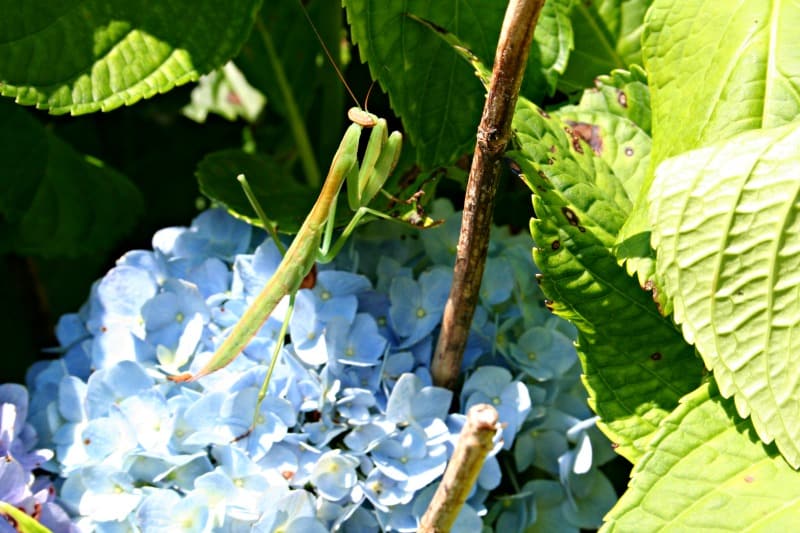
Among all the beneficial insects in the garden, I’m fascinated the most by the praying mantis. They seem both graceful and deadly, moving with precision and speed that often surprises me. I know why this particular beneficial insect has chosen my front porch for its hunting grounds. We have one of the doorbells that glows at night, and it attracts moths. By hanging over the doorbell area, he snags many flying insects each night.
Why Beneficial Insects?
Don’t be afraid of the bugs in the garden. When my little nephew was here, all he wanted to do was kill bugs. His parents had taught him “all bugs are bad,” and Billy the Exterminator is one of his favorite shows. When we walked around the garden, I had to stop him from stomping on bees, spiders, praying mantis, and ladybugs. I hope he remembered that some bugs are his friends, and not all bugs are bad.
In an organic garden, when nature rules, the insect populations are balanced. The “good” bugs like these feed on the “bad” bugs that harm plants. They keep them in check. Additionally, birds and other animals help keep insects that can harm plants in check, too. By making sure you nurture the good bugs like these beneficial insects, you’ll naturally lower the population of bad ones.