• Skip to primary navigation
  • Skip to main content
  • Skip to footer
Home Garden Joy
  • Home
  • Gardening Basics
    • Month-by-Month Gardening Tips
    • Home Garden Tips
    • Raised Bed Gardens
    • Seed Starting
    • Compost and Fertilizer
    • Tools & Equipment
    • Pests, Weed & Problems
      • Plant Diseases
      • Weeds & Invasive Plants
    • Butterfly Gardens
  • Plants
    • Plant Profiles
    • Herbs
    • Fruit
    • Vegetables
    • Flowers
    • House Plants
    • Trees and Shrubs
  • Birds and Wildlife
  • Home & Living
    • Thanksgiving & Christmas
    • Canning and Food Preservation
    • Easy Recipes
  • About
    • Herbalism Classes
    • Books for Christian Herbalists
    • Books by Jeanne Grunert
    • Privacy Policy

Ouch! Saddleback Caterpillar Stings

August 26, 2014 by Jeanne

Saddleback caterpillar stings hurt. Here’s how to recognize the saddleback caterpillar and treat saddleback caterpillar stings.
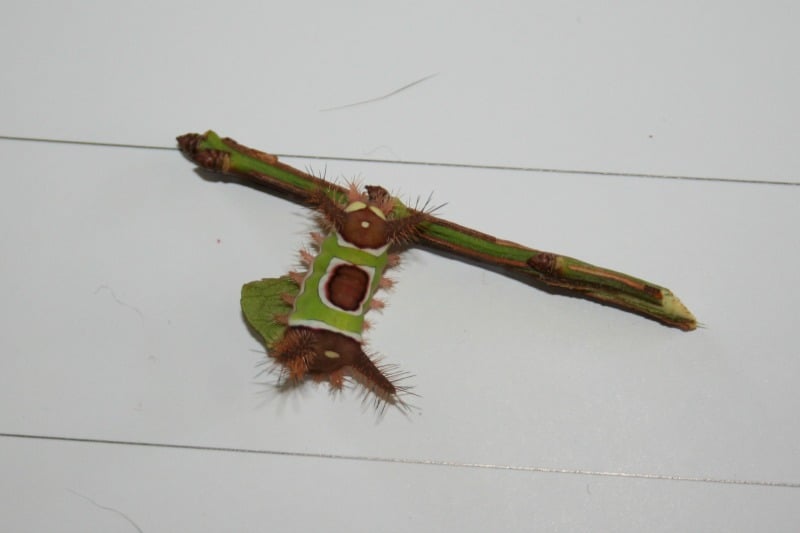
saddleback caterpillar


Do you see this ugly critter? It’s called a saddleback caterpillar, and until yesterday, I had no idea it even existed. I was working late when my husband came into the office holding his arm.

“Can you look at this?” he asked me, holding up his forearm and pointing to a red mark the size of a quarter. “I think I just got bit by something.”

It took him a minute to find that exact spot in the garden where he “got bit” by something. He quickly found the culprit clinging to a branch on a burning bush. “I just walked by the bush and my arm brushed against it,” he exclaimed. “It hurt like heck! Felt like a jelly fish sting.”

He brought the twig up to my office with the lumpy caterpillar clinging to it. It didn’t move. I photographed it, my mind reeling. I imaged having to show the photo to the emergency room doctors at the hospital. I quickly searched online for “stinging caterpillars in Virginia” and identified the creature.

Sure enough, the saddleback caterpillar produces a venom through the barbed spines on either end of its lumpy body that deliver a sting similar to jellyfish or bees. The venom can cause allergic reactions in some people, but fortunately, Hubby just had a red mark like a bee sting. We quickly applied tape to the area and ripped it off repeatedly, which also ripped off some of his arm hairs but seemed to do the trick removing the barbed stingers left in his skin. An ice pack and a few minutes later and he was good as new.

All I can think of is how many of these creatures are out there. A friend’s son was weeding her raspberry patch and encountered the puss moth caterpillar, and he had a massive allergic reaction and ended up in the emergency room.  I knew about black widow spiders and copperhead snakes, but stinging caterpillars???

There are more lurking in the garden.  For more, here is an information sheet from the Blue Ridge Poison Center.

Moral of the story: ALWAYS WEAR GLOVES WHEN GARDENING. And pants. And boots. And maybe a helmet, goggles, and astronaut suit…


 

Blog Signature butterfly

Filed Under: Garden Pests

Previous Post: « Fresh Food Wednesday: Easy Banana Bread Recipe
Next Post: Fresh Food Wednesday: Sweet Potato Pie Recipe »

Footer

A close up of radishes.

How to Grow Radishes from Seed: Easy Beginner Vegetable Garden Plant

I think every gardener starts with growing radishes. And why not? Radishes germinate readily, grow quickly, and add interest to salads. They’re also great when you have cabin fever after a long winter and you’re dying for something fresh from the garden. And while their spiciness may be an acquired taste, in some cuisines (including…

Read More

Bok choy leaves photographed from above

My Fall Experiment: Growing Chinese Vegetables

Every gardener loves a good experiment, and this year mine involved stepping outside my usual vegetable lineup. I tried growing a few Chinese vegetables in my garden, and the results were delicious, a little surprising, and a whole lot of fun. If you’ve ever wondered whether these crops are worth a spot in your garden,…

Read More

A close up of tatsoi, or vitamin plant, a Chinese vegetable, growing in a raised bed garden.

Growing Tatsoi: The Frost-Resistant Asian Vitamin Plant

Growing tatsoi (Brassica rapa subsp. narinosa (sometimes listed as Brassica rapa var. narinosa) offers fresh, leafy greens in USDA hardiness zone 7b throughout the fall and possibly the winter. Tatsoi isn’t sold in my local Kroger, Food Lion, or Walmart Super Center, but it’s easy enough to grow, and so delicious, that I plan to…

Read More

A pot of red chrysanthemums on a wooden packing crate with pots and yellow mums on the ground.

November Gardening Tips

Tidying Up, Winding Down, and Looking Ahead Here in central Virginia, the first hints of fall show up in October, and by the end of the month cool nights are the norm. By November, frost is a given, the leaves have all turned, and most of the trees stand bare. November is a month for…

Read More

  • About
  • Plant a Row for the Hungry
  • Awards
  • Privacy Policy

Let’s Connect!

  • Facebook
  • Instagram
  • Pinterest
  • Substack
  • YouTube

Copyright © 2026 Home Garden Joy on the Foodie Pro Theme