For many people with limited backyard space, or folks living in apartments or condos, growing fruit trees in containers allows them to enjoy the fun of growing their own fruit. You can even grow warm climate fruit like lemons or figs in containers and just move them indoors in the fall and winter. Here’s what you need to know about growing fruit trees in containers.
Growing Fruit Trees in Containers
Many types of fruit trees may be grown in containers. Apples, pears, peaches, figs and lemons are the most common. If growing apple tree in containers, make sure you select varieties marked “dwarf.” This refers to the tree size, not the size of the fruit. Dwarf trees stay under 15 feet tall and grow more easily in a pot or container.
Containers for Fruit Trees
Containers for fruit trees should be like the one shown in the photo above. They should be big enough to hold up a mature tree and provide plenty of space for the roots. A container or pot about 10 to 15 gallons is just about the right size for many types of trees.
You may wish to place the pot or container onto a wheeled dolly or casters so that you can roll it into the house during the winter. This is especially important for trees that can’t withstand cold weather, like fig trees or lemon trees. Pots, once filled with soil and a tree, are very heavy. Wheels make it much easier to move it.
Although stone containers are beautiful, they weigh quite a lot. Plastic or polyresin compounds can be molded and painted so that they look like old-fashioned concrete planters without the weight (or expense).
Be sure that any container you choose has several drainage holes drilled into the bottom. This allows extra water to drain away from the tree’s roots.
Soil
Fill your container with bagged potting soil purchased from a garden center. Potting soil works fine for trees.
Place several large rocks or a layer of gravel at the bottom of the container before filling with soil. Gardeners used to think that this helped with drainage, but new research shows it’s not important for drainage. Instead, it will help balance the top-heavy tree, especially as your fruit tree grows, and prevent it from tipping over. It will add weight and ballast to the container.
Light
All fruit trees need full, direct sunshine each and every day. Make sure that you place the tree where it can get the most sunshine.
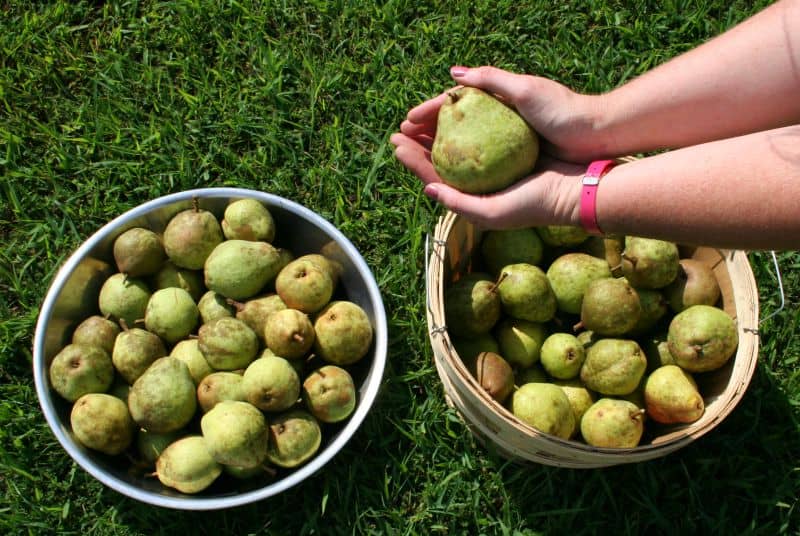
Pear harvest here at Seven Oaks, 2015
Choosing a Fruit Tree for a Container
Now we get to the fun part — choosing a fruit tree for a container! In a previous article, I wrote about how some fruit trees require a second tree for pollination. Apple trees fall into this category. If you don’t plant two ore more trees, you won’t get fruit. But you can get around that if you really want to grow an apple tree in a container.
If you can plant only one tree in a pot or container, you have several choices:
- Plant a self-pollinating species and variety, such as a peach tree.
- Buy a tree with two or more varieties grafted onto a single trunk so that you actually have two varieties in one tree. Many catalog companies sell “balcony trees” or container fruit trees with these characteristics. That’s why you can grow apple trees on patios even if you can only buy and care for one tree. The tree is actually two (or even more) in one!
- Plant two trees of different varieties.
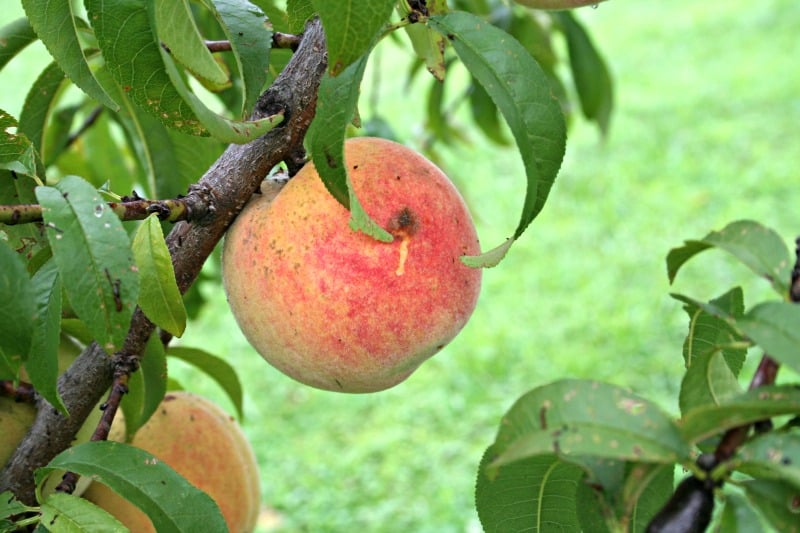
Peach trees can be grown in containers.
Caring for Your Fruit Tree
If you used potting soil with those tiny fertilizer beads already included in it, you don’t need to fertilize your fruit tree for the first year or even into the second year. Compost can be added as a top dressing, or a nice compost or manure tea watered into the tree for additional nutrients.
Water your new fruit tree only when necessary. Don’t douse it with water so that it stays soggy all the time. While you don’t want the soil to completely dry out, keeping it soggy is worse and may smother the tree. Trees “breathe” through both leaves and roots, and the roots can rot if they are submerged in water all the time.
Pruning
You patio fruit tree will need to be pruned just like its full sized, grown in the ground counterpart. Follow the guidelines for pruning the species of fruit trees you own. For example, apple trees are pruned in an open, “ladder” shape while peach trees are pruned in a more rounded form. More information on pruning will be included in future articles. Your local Cooperative Extension office will have information on how to prune fruit trees, so give them a call.
You can safely prune off dead branches while the tree is dormant (asleep) during the winter. Clean your pruning shears with rubbing alcohol between cuts to prevent any problems or diseases from spreading.
Pests and Diseases
Speaking of problems or diseases, patio fruit trees or container grown fruit trees can succumb to both diseases and pests just as easily as those grown in the ground. Microorganisms that cause rust, blight and other diseases can strike your container fruit trees, so watch them carefully and take steps to treat any problems that you see developing.
By far the worst problem I’ve ever encountered with patio grown fruit trees is one familiar to most gardeners: squirrels! Actually, it was my sister who was plagued by a determined squirrel who eyed her container apple trees on her patio with great interest. She waited all year, until finally her apple tree produced one perfect, glorious apple. Just when it was ripe, Mr. Squirrel picked it, took one bite out of it, and dropped it to the patio.
Squirrels are notorious fruit poachers. My cat takes care of our squirrels, and if your balcony is a few stories or floors up you should be fine. You can also place nets over fruit trees to keep birds and squirrels from harvesting your fruit.
How Much Fruit Will a Patio Tree Produce?
It’s almost impossible to predict how much fruit a tree will yield. A lot depends on the tree, the variety, the care and growing conditions.
Some will produce fruit the first year, but most need a year or two to become established and put down strong roots. After that, you may be able to pick and enjoy your first fruits. Have fun! Wait until they are ripe and celebrate the bounty.
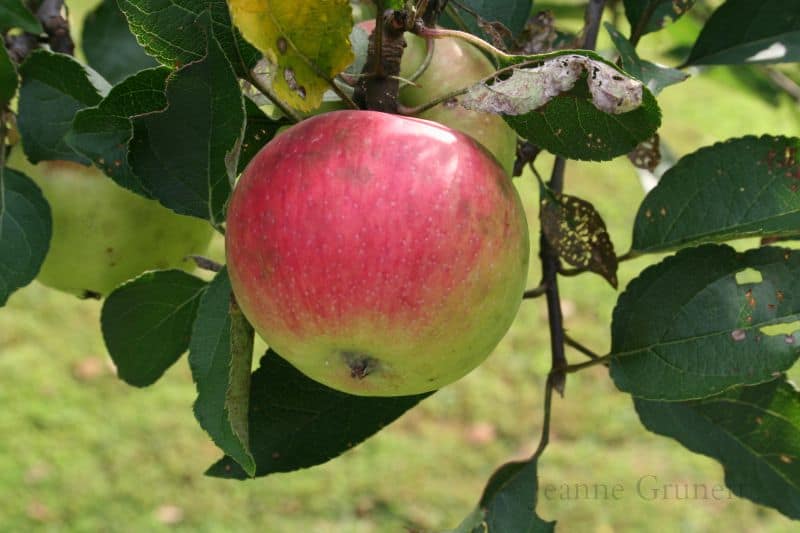
Dwarf apple trees can be grown in containers.
More Articles on Growing Fruit in Your Backyard
I hope you’re enjoying this series on growing fruit in your backyard! There are more articles to read, so take your pick, and feel free to share the links with friends: