 |
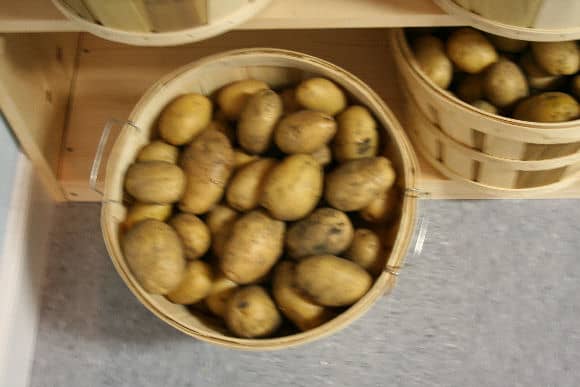
| Basket of Yukon Gold potatoes harvested July 2012 |
Despite the heat wave hitting south central Virginia last week, it was time to harvest the potatoes. We tried waiting until the heat wave finally broke but with each passing day, it became readily apparently that the potatoes needed to be dug, and now. So on Friday night, after the sun left the garden area and it was a “mere” 90 degrees, we trundled the wheelbarrow and a few buckets to the vegetable garden and began digging potatoes.
We planted potato slips or pieces of potato in late March in a 10 x 10 raised bed filled with soil and compost. The potato pieces were either small potatoes saved from last year’s harvest and stored in a brown paper bag in the basement or in the crisper drawer of the refrigerator, or pieces cut from a seed potato I purchased at the garden center. Each piece has to have an “eye” in it – that’s where the new plant sprouts develops. The instructions said to leave the pieces exposed to air for a day or two, which we did, and then we planted them. Rain watered them for the first several months. They were attacked by potato beetles, which ate a lot of the leaves, but we chose not to use any pesticides on the plants. We figured that there were so many potatoes that the beetles were welcome to a few leaves, and fortunately we were correct. The potatoes suffered no ill effects.
By late June, the foliage began to die back, and by the 4th of July most of the foliage had died. According to my books this is about the right time to harvest the potatoes, although some books say to wait a week or two after all the foliage dies back. We didn’t want to wait!
Last year I used a spade and fork to dig out the potatoes, but unfortunately I ended up hitting a lot of them with the tines of the garden fork and that ruined them. So this year we dug them up by hand.
The resulting harvest surpassed our expectations. By far the best potatoes were the Yukon Gold. These are now second year descendents from the bag of starter potatoes our neighbor and friend Mel gave us. The yield this year was 68 pounds of almost perfectly uniform potatoes, each the size of a big fist, well formed and with good skin. The Russet potatoes weren’t that great this year. Just 9 pounds dug from a lot of little starter potatoes planted in the spring. But like the Yukon Gold potatoes, the Russets were all a nice size for baked potatoes.
We dug the potatoes and let them dry overnight in a single layer in cardboard boxes in the garage. Then we sorted them by type and size and stored them in bushel baskets in the cellar. Now comes the maintenance part; each month we will need to go downstairs and pull off the sprouts, and check for any rotting potatoes. I don’t know an easier way of doing this. No matter what we have tried, the potatoes will sprout, and Mel, who gave us the potatoes to start us off a few years ago, said that his sprout, too. If anyone has tips to prevent sprouting let me know.
In the meantime, we ate our first baked potatoes – Russets – on Sunday. Home grown organic potatoes have a much stronger, richer, earthier flavor than store bought ones. It is such a great feeling to look down at your dinner plate and realize that you grew or raised nearly everything on it – grown less than 20 feet from the kitchen, in an organic garden where you know EXACTLY what conditions the plants were grown, harvested, and stored.
We’ve saved a bunch of seed potatoes and are hoping to plant a second harvest for the fall.
What tips can you give for growing potatoes?