This weekend we spent hours readying both the vegetable gardens and flower gardens for spring. With unseasonably mild temperatures on both Saturday and Sunday – it was in the 50s and 60s respectively – we decided to tackle two chores: cleaning up the horrible mat of weeds on the edge of the flower garden and filling the raised beds in the vegetable garden with compost. Of course, two projects led to about 10. Isn’t that the way of the garden? You start one thing, which leads to another, and before you know it you’re ankle deep in mud.
The flower garden along my driveway tends to get weedy, possibly because it’s next to the lawn and I think weed seeds just blow right off the farmer’s fields across the street and also from the lawn. Critters probably track in those weeds, too! Last year we could not keep up with the weeding in two spots. We still have pallets of stones stacked and waiting to go onto the walkways, and weeding around the pallets was impossible. A big mat of some kind of grass just spread and spread, engulfing a small part of the driveway and creeping into the iris and day lilies.
On Saturday, we began digging up the mat of weeds. What a chore! But luckily for us we got there just in time. Underneath the mat of weeds, choking for lack of sunlight, were crocus and daffodils. We moved a stone that had fallen off the pallet or been carelessly thrown onto the weedy patch and there were at least 30 crocus, struggling to grow under a heavy slate. I felt like I’d done my good deed for the day as we uncovered all the pretty spring blossoms.
It took several hours of heavy work with a pick axe, hoe and shovel, but we managed to dig up the mats and at least chop back what we couldn’t dig up so that we can put down some landscape fabric on the area we want to make a garden path and smother out the rest of those things.
After church on Sunday, I changed my clothes and headed out to the vegetable garden. I had stopped at Wal Mart to do some grocery shopping and meant to pick up only one package of Swiss Chard seeds in the garden center there – but I left with Swiss Chard seeds and more flower seeds: alyssum, shade flowers, nasturtium seeds, poppies. And then of course I spied lily of the valley pips and I wanted to add lily of the valley along the stone wall of our raised patio at the back of the house, so those found their way into my shopping cart. Then I spotted seed potatoes (potatoes specially grown for gardening) and horseradish. Hmm, into the cart those went. I came home with the trunk of my car filled with groceries and gardening supplies!
I thought my long-suffering spouse was going to have a fit, but he approved of my purchases. We ran 12 wheelbarrows of compost back to the raised beds and then paused to stretch our aching backs and survey the area. We talked about what grows well – greens, like Chard, spinach and lettuce; beans of all sorts; roots crops of all sorts. We agreed to forgo the melons this year since the ones we buy at the store or Farmer’s Market just taste better.
We decided to pull up what looked like just a few mint plants and ended up being an enormously thick mat of mint. We had to dig up the entire raised bed! That necessitated refilling the bed with more compost, of course. Because I can’t let a plant go to waste, we moved the big mats of mint down to an area at the bottom of the hill at the base of the fruit orchard, where rainwater tends to erode the soil. We planted the mint in that area. Who cares if it grows a bit into the woods or out onto the lawn? Mow it!
Next we tackled the strawberry bed. My poor strawberries were planted too close together, spread out all over the place, and had a big hunk of grass growing in the middle. We dug up the whole bed, split up plants, removed the grass, and replanted the whole kit and kaboodle.
I planted the lily of the valley pips, then planted two bags of gladiolus bulbs against the foundation of the house.
Then we headed inside, poured ourselves drinks, and collapsed in front of the TV. We were both popping Advil last night and grumbling about sore backs, but this morning, as I sit in my office and glance down at the flower garden, it’s nice to see the plants instead of the big ugly mat of evil weeds!
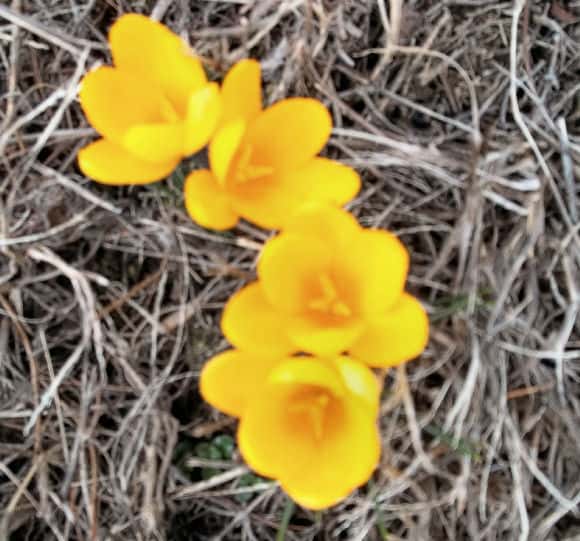
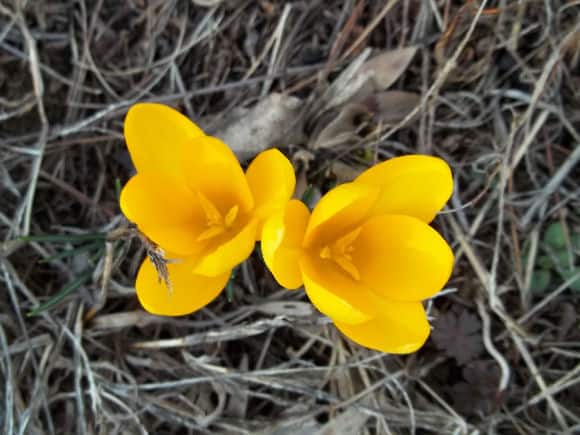
Today’s pictures are taken in our fruit orchard. We planted crocus and daffodils throughout the orchard. These are the first crocus of spring, blooming at the base of an apple tree.
Happy gardening!

Wow you had a productive weekend. I’m so ready to clean my garden beds but we keep getting snow. Oh well. Moisture is good. I love mowing mint. It makes the mower, then the garage smell good.
Hope you’re resting some today!
Ha! I’m an editor and writer by day, and today is deadline day for 2 sites I edit….no rest for the wicked nor the weary! We did step outside on the porch to admire the garden again through a curtain of wind-driven rain. Thanks for the comments dear friends – happy gardening!