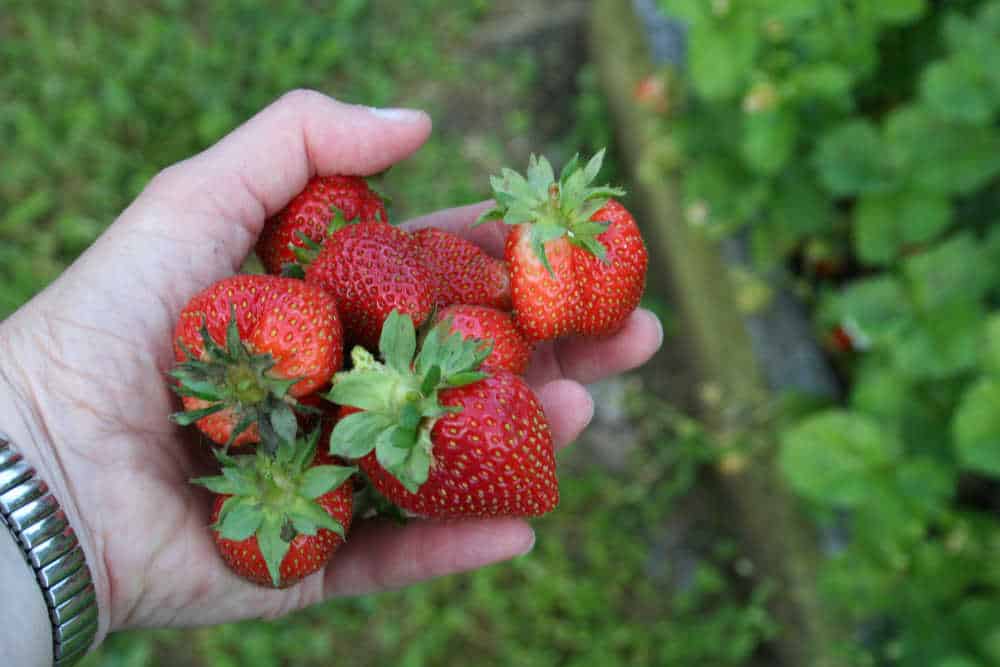
What caused deformed strawberries? I love strawberry season and devote an entire raised garden bed to our strawberry crop. Most were fine this year, but in one section of the bed, I picked several mutant berries.
What caused this? Radiation? Aliens? Alas, the answer is simpler than that, but the intriguing forms still hint at alien invasion…
What Causes Deformed Strawberries?
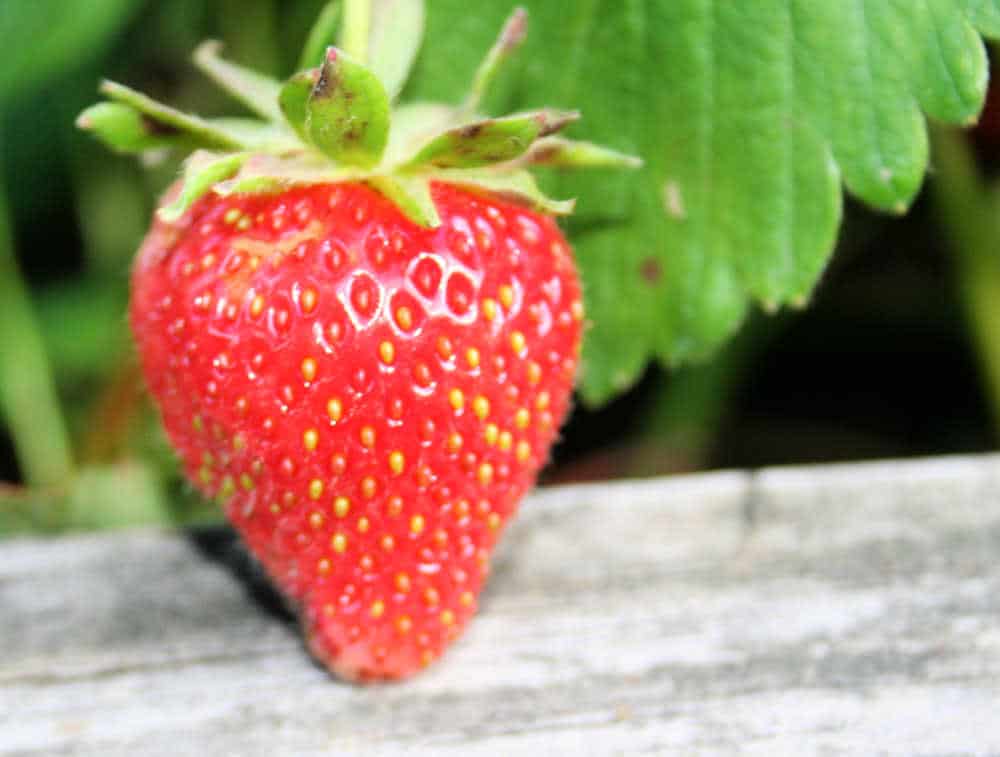
I was merrily picking strawberries and dreaming of all the yummy things I was going to make with them when I picked this berry:
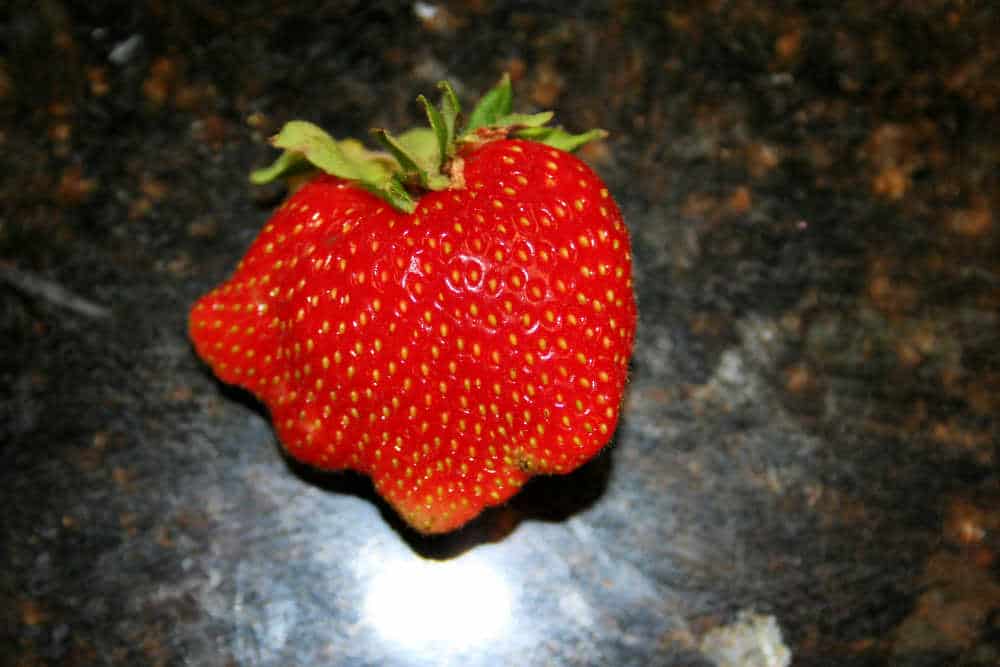
These strawberries were all bigger than normal and had two “caps” or green leaves at the top but one berry with multiple dips around the edges. I ate one, and it tasted fine, but it had two cores, two caps, and one stem.
What in the world happened? What causes deformed strawberries?
According to Cornell University’s College of Agriculture and Life Sciences, what causes deformed strawberries are several very common situations:
- A spring frost or interruption in pollination: Bees emerge from the hive when temperatures warm up, signaling the start of spring. If a late frost occurs, it may disrupt pollination. This is likely what happened to our strawberries. We did have a spot of warm weather, then a few nights with temperatures below 32 degrees F. The bees disappeared for a few days. We noticed this on our fruit trees, too – they were buzzing with activity, then silence. A similar effect happened on our strawberry plants and it is likely that only one flower was pollinated while a second flower on the stem may have been unpollinated. Or, two could have been pollinated and fused together. The bed is overgrown in the spot where I found the mutants, so that is also possible.
- Boron deficiency: Strawberries are sensitive to boron in the soil, and if there is a deficiency, dimpled or puckered strawberries are the result. My berries do not look like pictures on the ag site of boron deficient berries but some of you may have a problem with deformed strawberries so I thought I would list all the possible reasons. If you suspect a boron deficiency, the only way to tell for sure is to have the leaves of the plants analyzed at your local Cooperative Extension office. They can diagnose a boron deficiency by analyzing the leaves and then instruct you on what to add to fix the problem.
- Tarnished plant bug (Lygus lineolaris): Although relatively uncommon, tarnished plant bug nymphs can distort strawberries. The nymphs feed on blooming flowers and damage them during pollination. The resulting strawberries have small pimples or bumps on the surface usually near the stem. They may also have a bronze discoloration near the stems.
Figuring Out What Causes Deformed Strawberries and Fixing It
First, look at your strawberries. The telltale bronze colors near the stem indicate the tarnished plant bug. If your area experienced a frost, the weather is the most likely culprit. And if you aren’t sure? Take a leaf to the Cooperative Extension office and ask for help.
Now you know what causes deformed strawberries….but the big question is “Can you eat them?” YES! Go right ahead. Neither bugs nor boron deficiency nor weird shapes detracts from the taste or safety of the strawberries. Cut off the stems, core them if you like, and use them in your favorite recipe. They are just fine and I can personally attest, taste great!