• Skip to primary navigation
  • Skip to main content
  • Skip to footer
Home Garden Joy
  • Home
  • How to Garden
    • Garden Pests
    • Plant Diseases
    • Raised Bed Gardening
    • Seed Starting
    • Tools & Equipment
  • Plants
    • Plant Profiles
    • Vegetables
    • Fruit
    • Herbs
  • Recipes
    • Canning and Food Preservation
  • Books & Classes
    • Books by Jeanne Grunert
    • Books for Christian Herbalists
    • Herbalism Classes
  • About
    • Privacy Policy

Garden Guests: Wolf Spiders

June 5, 2010 by Jeanne

This morning I went out to weed the flower garden before the heat soared, and encountered two unexpected visitors close up and in person. One resulted in a bee sting before I could withdraw my hand quickly enough from the patch of  Gaillardia I was weeding.  He got my just above the edge of my gardening gloves, about halfway up the arm, but I managed to whisk the bee off before the stinger penetrated too far, so aside from a bit of sting and redness I’m all set.

But then there was the wolf spider.

Do you have wolf spiders in your area? In North America there are 125 species and they are everywhere. They are the size of tarantulas. The body is about 1 to 2 inches long, and with the legs they’re about 4 inches long at maturity.  Here is more information and photos of them: wolfspider.org

I surprise many in the garden. Today I tackled the weeds at the entrance to the garden path and the thousands of morning glories that seeded throughout the flowers beds near the entrance. I pulled up a stone, and a very large, very frightened wolf spider bolted out.

She carried the most exquisite turquoise-colored egg sac on her back. Wolf spider females carry their eggs with them in either a white or robin’s egg blue egg sac attached to the abdomen. Around my garden, many of the females have beautiful blue egg sacs ranging from the palest blue to a deep, rich robin’s egg blue.  Today’s mama had a turquoise colored sac.

Wolf spiders do bite, but only if they mistake your finger for an insect.  They prefer insects and mama spider was more interested in finding a safe rock to hide under than she was at biting me.

When the babies hatch, they cling to the mother’s back. It’s not uncommon for me to stop and wait while a mother wolf spider races across the road in front of us as I walk Shadow in the morning.  I marvel at the hundreds of tiny babies waving their legs at me as if to say, “Thank you!” Sometimes I feel like a crossing guard.

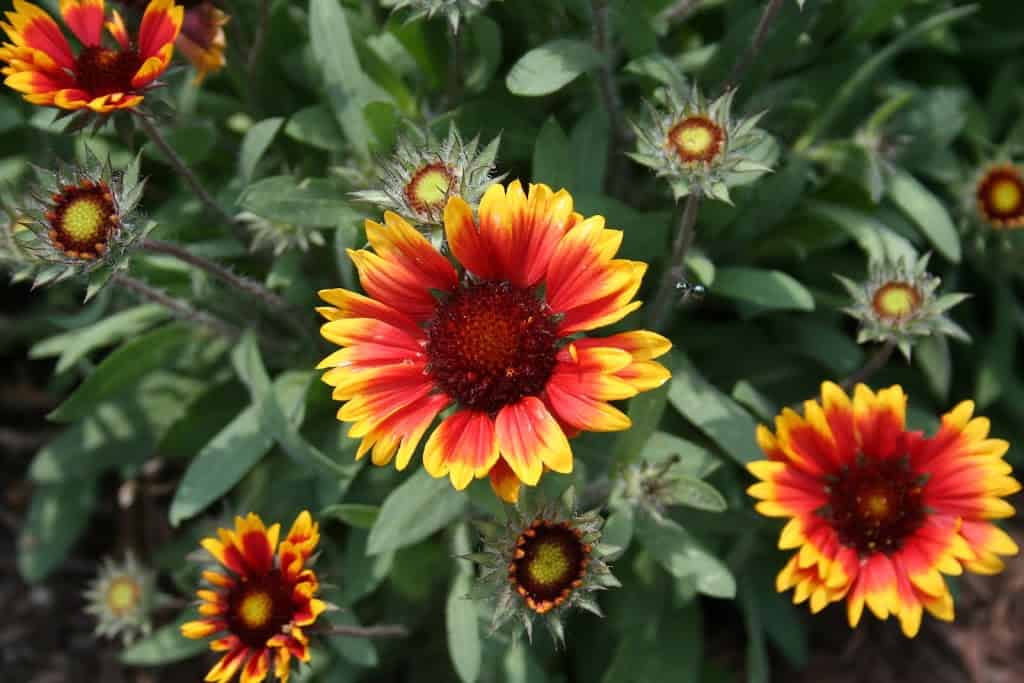
No picture today of spiders.  I’m not fond of looking at them myself. Instead, here’s the sunny face of a Gaillardia near where Mr. Bee got me.
Filed Under: Birds and Wildlife

Previous Post: « The Battle Rages On: Squirrels Versus Hummingbirds
Next Post: Shadow, Destroyer of Plants »

Reader Interactions

Comments

  1. ~Gardener on Sherlock Street

    June 5, 2010 at

    Hope your sting is feeling better. We have wolf spiders in our garden. My husband almost sat on one the other day while picking strawberries. I haven’t seen the brightly colored sacs you describe. I will watch more closely.

  2. ~Gardener on Sherlock Street

    June 6, 2010 at

    I had to come back to tell you that I was out watering my strawberry plants when a wolf spider carrying an egg case went running out of the “rain.” She had a grayish white case bigger than her body.

Footer

a wheelbarrow with bag of soil, trowel, pots and plants

Understanding Fertilizer: A Complete Guide for Home Gardeners

Understanding fertilizer is an important skill for beginning gardeners. In this guide, I’ll walk you through the basics. By the end of this article, you’ll understand fertilizer, what it is and what it does, and how to use it appropriately in the garden. Introduction: Why We Use Fertilizer in the Garden . Plants absorb nutrients…

Read More

red lettuce, mexican tarragon, and chard

The Best Organic Fertilizers

If you’ve been looking for ways to help your garden truly thrive — not just survive — organic fertilizers might just become your new best friend. They’ve become a cornerstone of sustainable gardening and farming, and for good reason: they don’t just feed your plants, they actually improve the health of your soil over time….

Read More

water droplets in sunbeams over a raised bed vegetable garden

Irrigation Tips for Home Gardens: Drip vs. Soaker Hose

Watering is one of the most essential tasks in maintaining a healthy home garden, yet it is also one of the most misunderstood. Many gardeners rely on overhead sprinklers or hand-watering, both of which can waste water and fail to deliver moisture efficiently to plant roots. Two of the most effective alternatives are drip irrigation…

Read More

chive plants in bloom with lettuce

The 10 Easiest Herbs to Grow

Grow them in pots, containers, window boxes, raised beds, or tucked among your flowers. These are the 10 easiest herbs to grow in almost any temperate garden. They take up little space, are generally unfussy, and are used in lots of recipes. What Do I Need to Start an Herb Garden? You don’t need a…

Read More

  • About
  • Plant a Row for the Hungry
  • Awards
  • Privacy Policy

Let’s Connect!

  • Facebook
  • Instagram
  • Pinterest
  • Substack
  • YouTube

Copyright © 2026 Home Garden Joy on the Foodie Pro Theme