• Skip to primary navigation
  • Skip to main content
  • Skip to footer
Home Garden Joy
  • Home
  • Gardening Basics
    • Home Garden Tips
    • Month-by-Month Gardening Tips
    • Seed Starting
    • Compost and Fertilizer
    • Butterfly Gardens
    • Tools & Equipment
  • Raised Bed Gardens
  • Plants
    • Plant Profiles
    • Herbs
    • Fruit
    • Vegetables
    • Flowers
    • House Plants
    • Trees and Shrubs
  • Pests, Weed & Problems
    • Plant Diseases
    • Weeds & Invasive Plants
  • Birds and Wildlife
  • About
    • Books & Classes
      • Books for Christian Herbalists
      • Herbalism Classes
      • Books by Jeanne Grunert
    • Privacy Policy

Pathways for a Raised Bed Vegetable Garden

March 3, 2014 by Jeanne

One of the most important aspects of planning a raised bed garden is making sure you have good pathways between the beds. Pathways not only provide you with access to the beds, they can make it easy – or difficult – to move soil, compost, and materials in and out of the garden. 
Many gardeners have a preferred material for pathways.  I attended a raised bed gardening lecture last year, and the woman presenting the lecture raved about using pebbles on her pathways.  I’ve also heard people recommend mulch.
I’ve found both have pros and cons, and my preference is grass. As you can see, there’s often no one right answer to gardening questions. Most people recommend what they’re familiar with based on experience, research, trial and error.

Pathway Size: Planning Your Paths
Pathways between the raised beds must be wide enough to accommodate equipment such as a wheelbarrow, but not so wide that you find it difficult to water among the beds or perform other necessary tasks.  Most gardening sites recommend that paths be 3 to 5 feet wide, and I’ve also found this to be a good width.
My own are around 4 feet wide, which I can mow with two passes through on the lawnmower. The paths are wide enough so that my old-fashioned, hand-me-down wheelbarrow can maneuver between the beds, yet not so wide that I can turn and pick a tomato from one bed and easily reach the peppers behind me.
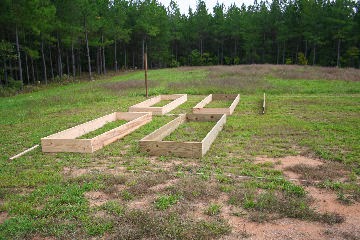
When you’re planning your raised bed garden, use string or rope to mark out the width. We used pieces of wood to mark off the imaginary lines where our beds would be, and then once the frames were in place, we moved them around to suit ourselves. The picture below shows my vegetable garden under construction. We made a few raised bed frames, then moved them into position and experimented with the width until we found one that worked.
 

Materials for the Pathways

As I mentioned before, the materials for vegetable garden pathways that gardeners recommend are often based on trial and error and their own personal preferences. When I researched this topic to build my garden beds, some websites advised against pebbles, saying that it would make the garden area warmer by reflecting the sun’s rays back up and onto the beds. I live in south central Virginia where the summer sun can be fierce – hotter I do not need!  So I opted for natural, cooling grass.
One person I spoke with also recommends mulch. I would say that if you use pebbles or mulch as a base for your pathways, lay down landscape fabric first to cut down the weeds. Yes, it can be expensive, but any steps you can take to avoid weeding are good steps.
There are pros and cons to using various materials:
  • Pebbles – Pros:  Attractive looking. Water drains well. Prevents weeds.  Cons: Expensive. Can be hard to push heavy wheelbarrows through. May reflect undesirable amounts of heat.
  • Mulch – Pros: Attractive. Easier to push wheelbarrows through than pebbles. Prevents weeds. Cons: May harbor plant diseases or microbes. Breaks down and must be replaced over time.
  • Grass – Pros:  Natural. Can use existing grass. Cuts down on heat.  Cons: You have to mow it frequently. If allowed to go to seed, can spread grass or weed seeds into vegetable beds.
Consider the pathways carefully before building your garden. A good path can make it easier or more difficult to tend your vegetable garden.
For more information on building raised bed gardens, see Cornell Cooperative Extension’s website.
If you enjoyed this article, you may enjoy:
  • Collection of Raised Bed Vegetable Garden Links
  • Replenishing Raised Bed Garden Soil
  • How to Build a Garden Using Raised Beds

Filed Under: Raised Bed Gardening

Previous Post: « Designing a Raised Bed Vegetable Garden
Next Post: March Gardening Tips Are Ready »

Reader Interactions

Trackbacks

  1. How to Plan a Raised Bed Vegetable Garden - Home and Garden Joy says:
    December 4, 2014 at

    […] Paths for a Raised Bed Garden […]

  2. Replenishing Raised Bed Garden Soil - Home and Garden Joy says:
    June 11, 2015 at

    […] Pathways for Raised Bed Gardens […]

  3. Soil for Raised Bed Vegetable Gardens - Home and Garden Joy says:
    June 11, 2015 at

    […] Paths for Raised Bed Gardens […]

  4. How to Build a Vegetable Garden Using Raised Beds - Home and Garden Joy says:
    March 15, 2016 at

    […] Pathways for a Raised Bed Garden […]

Footer

A close up of American burnweed flowers about to bloom.

American Burnweed, the Weed That Signals Fall Is Here

I was walking my dog along the wood’s edge right near where we cleared land to build our greenhouse when I did a double take. There, like Jack’s magical beanstalk, had grown overnight this gem: American burnweed. Also known as fireweed or American burn weed, it grows rapidly – and I mean, rapidly. Like I…

Read More

Summer squash

What Can You Make with Summer Squash?

It’s that time of year when everyon asks, “What can I make with summer squash?”. The time when neighbors sneak bags of summer squash onto porches. When farmer’s markets are brimming with yellow and green squash, zucchini, and all manner of Cucurbitaceae, the plant family that gives, and gives, until it can’t give anymore. If…

Read More

A closeup of marshmallow plant flower.

Growing Marshmallow Plant

Growing marshmallow plant has been on my gardening to-do list for quite some time. I’ve read about it in herbal books and grown its cousins in the Malvaceae family from seed. The dark purple mallow plant I have thrives in my little garden by the shed, so I thought, “Why not grow marshmallow there?” I…

Read More

watering can with plants

August in the Garden: Late Summer Delight

August in the Garden: Tasks, Tips, and a Look Ahead to Fall Here in South Central Virginia, August has always felt like “back to school” season. By mid-month, the local schools are back in session, and with two universities in our small town, the stores fill up with dorm supplies and school gear. What a…

Read More

  • About
  • Plant a Row for the Hungry
  • Awards
  • Privacy Policy

Let’s Connect!

  • Facebook
  • Instagram
  • Pinterest
  • Substack
  • YouTube

Copyright © 2026 Home Garden Joy on the Foodie Pro Theme