
I’ve loved this little folk art weather house all my life. It still makes me smile. What gardener doesn’t need to know the weather?
I grew up with many German relatives. Thank-you notes were written to “Oncle Ludwig” and “Tante Marie.” During visits to their homes, I was fascinated by the little folk art German weather houses (or weather haus) that stood on every hall table in a German household I can remember. Such folk art houses have been around for approximately 200 years. You can find cheap ones with plywood sides and fake plastic trees, all the way up to antique ones, Hummel figurines, and even Disney weather houses.
But this weather house meant the world to me, and inspired my curiosity into how they work.
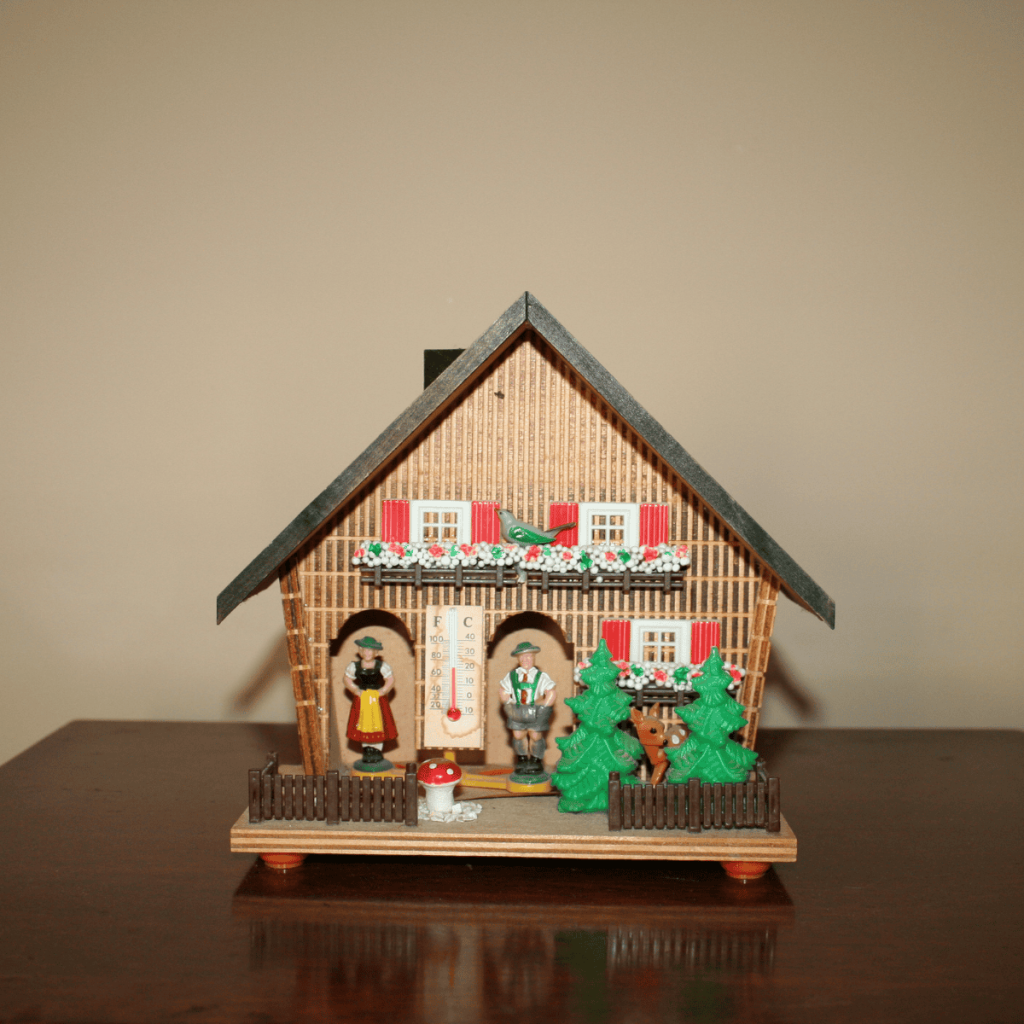
How the German or Folk Art Weather House Works
Each little weather house is typically shaped like a German or Swiss chalet with two doors. On the left is a girl or woman in a dirndl skirt; on the right, a boy in liederhosen. Some weather houses depict the boy holding an umbrella aloft to indicate rain. Many have a thermometer attached to the house between the two little doors, as the one I inherited from my Uncle John, shown in these pictures, does.
When the weather changes, the moisture in the air affects a piece of string or catgut suspended beneath the swinging stick on which the two little figures are attached. As the string expands and contracts with changes in moisture, it swings the little figure out to greet the day.
How Accurate Are Weather Houses?
How accurate are these little weather houses? Surprisingly, they are very accurate – or at least mine is!
The one pictured here is a cheap model with plastic figures. It is probably 50 years old or maybe a little older, and it has been standing on the telephone table in my uncle’s house for as long as I can remember. It was covered with dirt and cat hair when my sister rescued it and shipped it to me, and some of the little plastic trees were broken. I read the directions on the back and set the figure for today’s weather, adjusting the red knob on top of the chimney.
Two days later, I noticed the figures were shifting. By the end of the day, the boy indicating ‘rain’ was peeking out of the house, chasing the sunny girl figure back inside.
I checked the weather. Rain predicted for the next day. By the time the rain fell, the boy figure was fully out of the house.
Later that day, the skies cleared and the sun shone, yet the boy figure was still out of the house. Since the little weather house was so dirty and old when I got it, I thought, “Well, it must be broken.” I went about cooking dinner and thought nothing more of it until the patter of rain on the metal exhaust fan over the stove made me check outside. Sure enough, the clouds had come back, and it was raining again. The sunshine and blue skies were only a momentary break in the thick bank of clouds preceding the cold front. Somehow, my weather house “knew!”
Collecting Vintage German Barometer Weather Houses
You can find modern folk art weather houses in gift shops, online, and in German folk art shops. Many shops that sell cuckoo clocks also sell these little barometer weather houses.
Small Weather Houses
Vintage ones are fun to collect and relatively inexpensive. German barometer weather houses, such as the one I inherited, made with plastic figures, were usually produced after World War II. Depending on size and condition, you can find vintage German barometer houses starting at $9.99; new ones retail for about $20-$30.
Larger Weather Houses
Large, ornate, and antique weather houses can cost several hundred dollars. There are also spinoffs of the German barometer house. Disney produced some with its characters rather than the typical tiny people. The Hummel company made one with its trademark Hummel figures.
Display Your Vintage German Barometer Weather Chalet
Most of these little German barometer weather houses have a hook on the back to hang them on a wall. You can hang them in a hallway or kitchen so you can easily see the weather change. Because most have a flat bottom, they can also be displayed on a shelf or tabletop. A glass cabinet keeps true antique German weather houses from gathering dust or breakage.
I love my little weather house and keep it in the plant room. The string seems to have broken, and the figures no longer move, but I don’t care. Every time I look at it, I am reminded of Uncle John and Aunt Betty. I think of their kindness and love for my siblings and me. I’m transported back to Sundays visiting their beautiful home in Yonkers. The sunlight streamed through their plant room onto the telephone table where the sunny girl and rainy boy held court.



Leave a Reply
You must be logged in to post a comment.