
It’s time for tree planting whether we like it or not! Our baby trees have arrived, and it’s time to get them into the ground.
Tree Planting Time on the Farm
It’s in the thirties. There’s a thin layer of snow and ice on much of the ground. And yet we must plant our trees. Tree planting work was in the forecast for us today, cold or not! On went layers of clothing and gloves and out we went to take care of our new trees.
How We Plant Our Trees
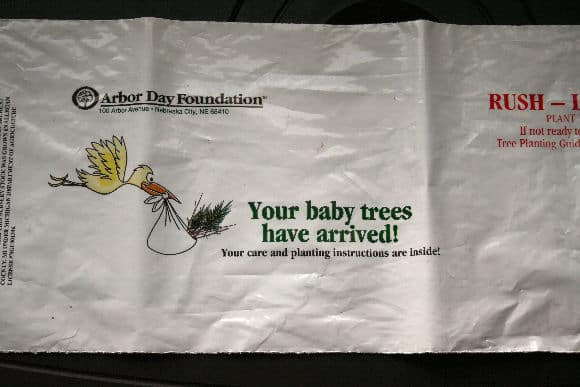
We have 10 Colorado Blue Spruce to plant on our tree farm. They came in a bag from the Arbor Day Society, tiny little things about 10 inches tall but with good roots. The Arbor Day Society sends them in a bag with a stork picture on it. How cute is that?
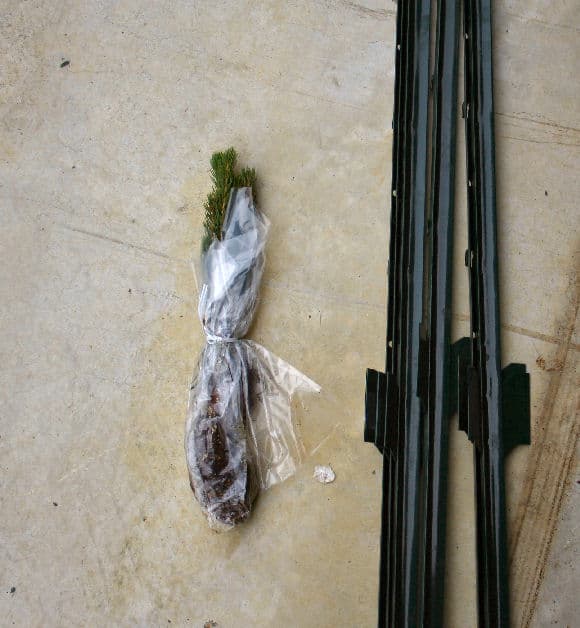
Once the baby trees get here, we must plant them within a day or so. The instructions that came from the Arbor Day Society instruct us that if we can’t plant immediately, the trees must still be heeled in, or planted in a shallow trench and moved later. We tried that one year and lost all the trees, so this year – snow or no snow, cold or not – we’re out there planting trees.

In the morning, we bring the trees in from the cold garage into the warm house. We place them in a basin of warm water to rinse off the solution they’re shipped in, a gel-like material that keeps them moist. Here are the trees sitting on the drainboard in my kitchen (!).
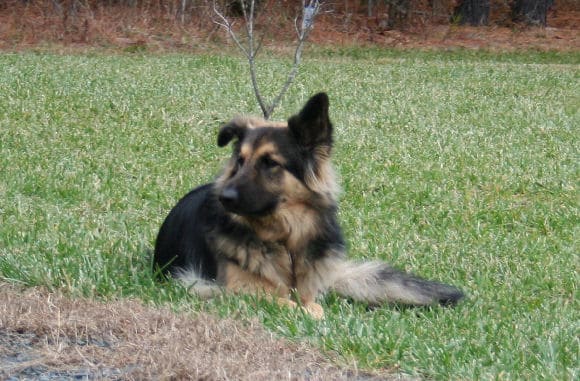
Time to plant the trees. First thing’s first – the dog must be on guard. Shadow finds a spot of grass without snow and settles in to watch our backs while we work!
Luckily, the ground is soft. John digs the hole with the pick axe. We use an axe like this instead of a shovel because our land has a lot of rocks under the soil, some quite large. We’ve learned by experience that the pick axe has a good pointy end to wedge up any rocks lurking under the soil.

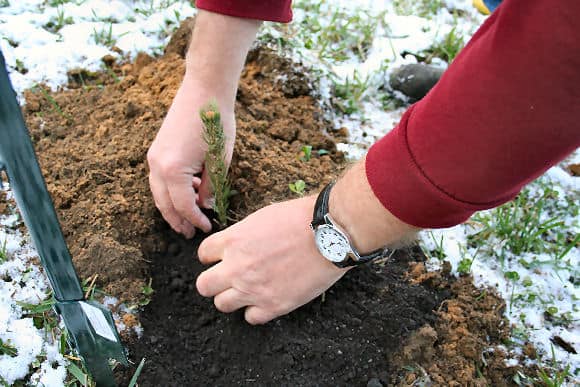
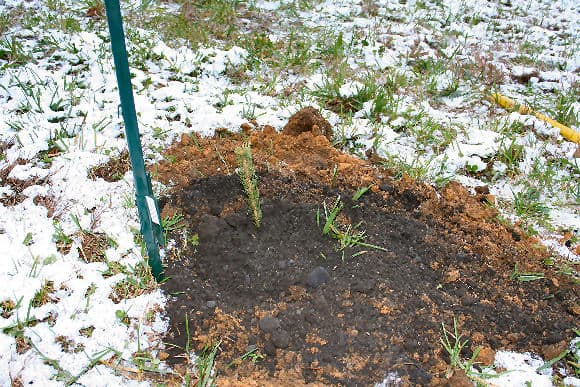
My job is to use the old metal pails to fetch compost. I bring over two at a time. As one of us holds the tree in place, the other person fills in the rich black compost. You can see how the soils contrast; the red clay with loam mixed in, and then our black compost.
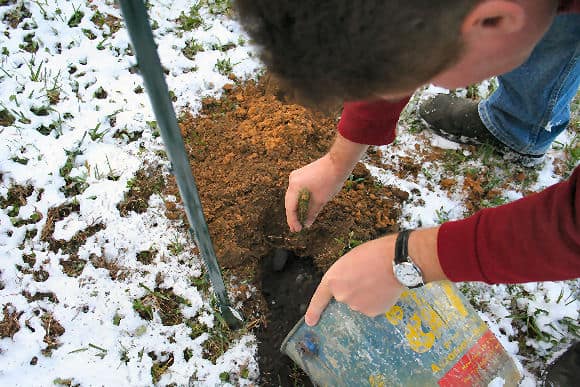
I pour water around the trees and we tamp down the compost. The green metal stakes mark the tiny trees so we don’t step on them or run them over with the lawn mower.
We will know by this time next year if these babies make it or not. The first year, they spend most of their energy putting down roots. The second year, as we can see from trees planted in 2008, they add lots of nice side branches and grow up a few inches. It is hard to imagine that these tender babies will one day be soaring, gorgeous Colorado Blue Spruce standing in the field!
Is there a patron saint for trees? I hope yours do well.
Hi Jeanne,
Thanks for sharing your step-by-step tree planting experience! It is a mind-boggling to think about how big these trees might become. There is lots of potential in those tiny babies;-) I hope they will live long lives! Have a wonderful holiday season!