
Have you thought about starting a compost pile, but you’re wondering how to start composting in winter? I mean, after all, here in Virginia we just had three solid weeks of absolutely tundra-like temperatures. I had a sheet of ice for a lawn, and the raised bed garden was completely covered in a thick layer of what the Virginia Department of Transportation named “snowcrete” – snow that was as frozen as concrete.
There was no way I was trekking across the tundra to my compost pile. None. I started at it forlornly through the kitchen windows and made do with a collection bucket in the garage (more on that later).
Today, the ice has finally melted. I can walk to the compost pile without Yak Traks (ice cleats).
I can also answer the question how to start composting in winter. It’s possible. If you’re serious about growing a fantastic organic garden this year, start composting now. There’s no time like the present.
How to Start Composting in Winter
First, let’s answer the obvious question if you’re new to gardening: what is a compost pile? What is compost, and why is it important?
What Is a Compost Pile?
Compost consists of decomposed plant materials. This includes things like leaves and grass clippings. It can also include kitchen scraps, like banana peels, apple cores, and things like that.
We make compost by piling up plant materials and allowing water and heat to “cook” the pile and decompose the materials. Naturally occurring bacteria and other microorganisms help break down the plant material into natural fertilizer that feeds the soil. That natural fertilizer is compost.
Good compost has the consistency of chocolate cake – rich, dark, crumbly. It should smell earthy but not sour. It can be added to your garden beds at any time. You can mix it in or sprinkle it on top. The more, the merrier.
Is Compost Different from Manure?
Yes and no.
Manure is feces produced by animals. Manure used in gardens should only be droppings from herbivores, never carnivores. An herbivore is an animal that eats plants: cows, horses, rabbits, goats, sheep. Carnivores are animals that eat other animals: dogs, cats. Carnivore feces shouldn’t be used in gardens because it can spread pathogens and parasites that can make people sick. (The same goes for human waste, which should also not be used in gardens).
Herbivore waste, on the other hand, is generally safe, especially once it breaks down a bit. The bagged kind of cow manure you buy at the garden center may also be heat treated to kill any remaining parasites.
Manure should be well broken down or ‘aged’ before applied to garden soil and plants. It can be very rich and burn plants with too much nitrogen if it is not aged properly.
Compost, on the other hand, can always be safely applied.
Winter Composting: Start with What You Have
Now let’s talk about my tundra, or the backyard covered in snow. It’s not very conducive to gardening, is it? So why would you want to start composting in the wintertime?
Why Should You Start a Compost Pile in the Winter?
- Starting your compost pile in the winter gives nature plenty of time to break down the materials before you add them to your garden. You’ll have less time to wait, more compost for your garden.
- It keeps useful materials from landfills. We humans, as a species, create a lot of waste. Starting a winter compost pile keeps useful plant material from the landfills and adds it back where it belongs – into the soil.
- You’ll get a headstart on your garden this spring.
The Useful Compost Bucket – Collecting Scraps
Now let me get back to my compost pail. I keep a $5 Lowes plastic bucket (around 5-10 gallons) in the attached garage. The garage door is just steps from the kitchen. I keep a small compost collection pail next to the sink, where I typically prepare food for cooking. It is a small wastebasket purchased from Walmart. I collect fruit and vegetable peels throughout the day in this small pail. Each evening, while I am cooking dinner, I dump the kitchen pail into the collection pail. Once a week, I take the collection pail to the main compost pile, which is located near the raised bed garden. I dump it there and rinse both buckets and done!
It’s a simple system that works well for my garden, which is large. I have a lot of steps to walk, so I prefer to collect small amounts of compostable material throughout the week. You could just as easily take it out daily. Either way, set yourself up for success:
- Buy a small pail to keep in the kitchen to collect scraps.
- You can also recycle a coffee can and use that to collect your compost scraps
How to Start a Compost Pile – No Equipment Method
Some people will say you need special equipment to create a compost pile, like a tumbler. These are plastic barrels on a frame that you can use to turn the compost. Air and water mixed with the plant materials helps them break down so this does save a step, but it is not necessary.
My first compost pile at my new house was quite simple and started in the winter. I outlined with rocks and bricks a square near the garden. Then I dumped my kitchen scraps in the square. I added layers of leaves about an inch or two thick, then grass clippings. Think of it like assembling a lasagna. Add the layers, then repeat them.
This method started a cold pile. A cold pile means it decomposes slowly. When the warm weather comes, you will find the pile heating up, which speeds up decomposition. You can also add more green plants like grass clippings. The fresh green grass decomposes, which warms the pile.
I share other methods of starting a compost pile and more on winter composting elsewhere on Home Garden Joy.
Building a More Elaborate Compost Pile
Winter is also an excellent time to build a more elaborate compost pile. In fact, we built “the monstrosity” (as a friend dubbed it – the name made us laugh), our huge concrete composting system, in late February and early March. The weather is too cold to work the soil. We typically finish the orchard tree pruning by now. So we built a compost system instead.
Ideas to Build a Compost Pile Framework
I have built three complete composting systems over the years, not counting just piling it up as previously described. Here is what I’ve used to build a more elaborate compost pile:
- Chicken wire stretched in a circle. The holes in the chicken wire allow air and water circulation but contain the pile.
- A large garbage can with holes poke in the side for air circulation.
- Bricks piled to make a wall, using a fence as one wall.

The concrete monstrosity I use now was built with foundation bricks and poured concrete. Holes in the blocks allow air and water to circulate, but unfortunately, they also allow plant roots to enter. Honeysuckle constantly invades, and I am constantly pulling it out. We sloped the concrete floor for water drainage.
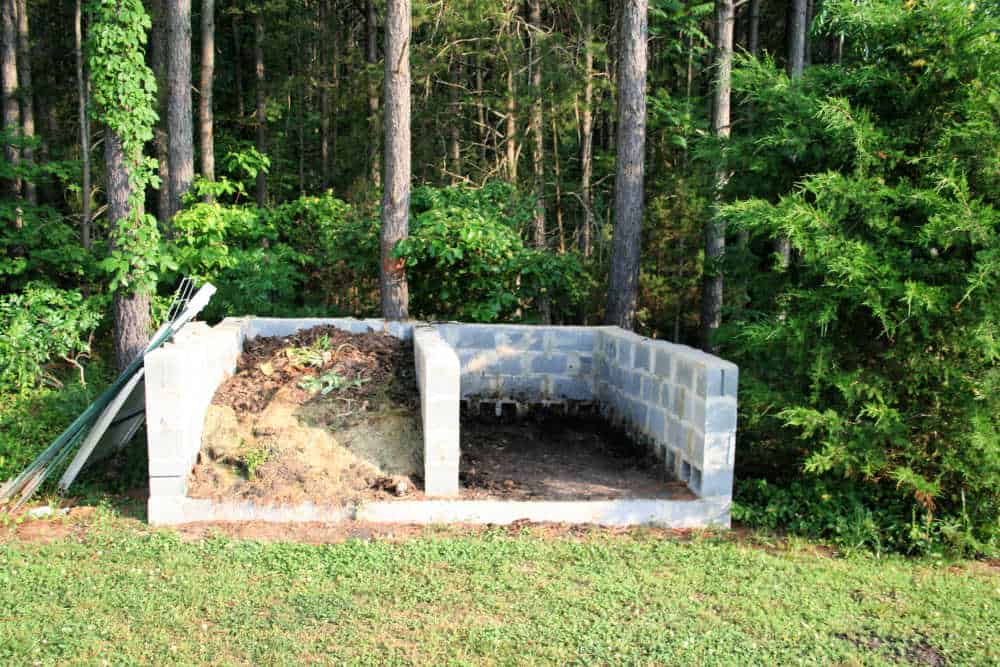
Autumn leaves, grass clippings, and kitchen waste form the basis of my compost pile. It breaks down quickly. I also purchase mushroom soil or mushroom compost, the leftover soil used by commercial mushroom farmers. It is rich in nutrients and adds great fertility to my raised beds.
One side is actively composting while the other is in use. In the picture above, the left side is my active side. This is where I add new material. The right side is where we were taking fresh compost the year this photo was taken. We switch sides in the fall, so each year, we rotate the composting areas.
Ready to Start Composting?
There’s no time like the present. You can start to build your compost pile today. You don’t need fancy tools or products. Nature makes compost naturally on the forest floor from leaves and plants. So can you with a simple pile!

[…] no reason to stop adding to your compost pile in the wintertime. In fact, if you keep adding to it over the winter months, the bacteria will take advantage of any […]