
The other night, Hubby and I were walking Shadow along our quiet country road when we spotted a woolly bear caterpillar. Woolly bear caterpillars are quite common sights around here, and they were common back on Long Island where I used to live, so I feel like they’re old friends. I always stop to say hello to them and watch them as they wriggle their way across the pavement. They always seem to cross the road from the cattle field to the woods at this time of year, perhaps heading for deeper cover against the snow and cold.
“Look at this one!” Hubby exclaimed, pointing to the fuzzy caterpillar. “He doesn’t have any black on him at all. What does that mean?”
We both love the myth that a thick black band on a woolly bear caterpillar means a harsh winter. Woolly bears typically have black bands on both ends, with a large reddish brown stripe in the middle.
But then we encountered this fellow:
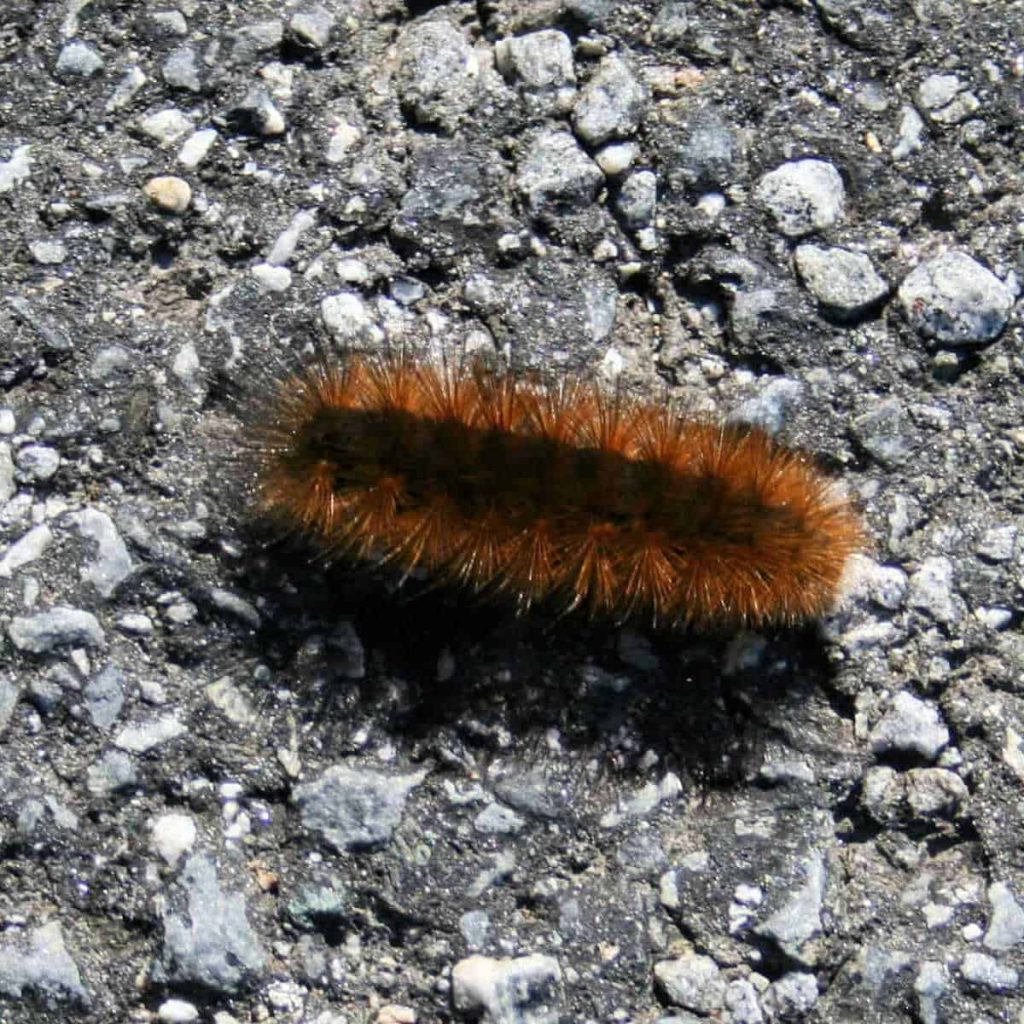
What does it mean? Does our woolly friend think he’s in Miami? Why does he have so much brown and very little black on his coat?
What Is a Woolly Bear Caterpillar?
Woolly bear (Pyrrharctia isabella) caterpillars are found throughout North America, although more common along the northeastern, eastern seaboard to the midwestern areas of Canada and America. They eventually metamorphose into a nondescript tan colored moth called the Isabella tiger moth.
The woolly bear caterpillar has 13 segments or joints on his body, which are thought to correspond to the 13 weeks of winter. You can’t see them just be looking at the caterpillar, however; his thick fluff covers it. The 13 segments may have led to the myths that correlate the caterpillar’s colors to the length of winter.
They’re very timid caterpillars and will play dead if bothered by people, birds or animals. Unlike the pus moth or the saddleback caterpillar, which stings with its furry poison-tipped spines, the woolly bear is a gentle fellow. The fur along his segmented body is probably a natural mimic of his more aggressive cousins in the insect kingdom; birds take it as a warning to leave him alone even though he’s quite harmless.
The Myth of the Woolly Bear Caterpillar to Tell the Winter Weather
The legend I always heard as young girl growing up in New York was that the width of the black bands foretells the severity of the winter; the broader the bands, the harsher the winter.
Other myths abound in different parts of the United States, however. In some parts of the country, the myth of the woolly bear caterpillar states that it’s not the broadness of the black bands that foretells the winter weather but the thickness of his coat. The thicker the coat, the harsher the winter. In that case, my russet-colored friend predicts a harsh winter, indeed.
My research into the legends of the woolly bear caterpillar, however, led me to yet another legend. This one states that the direction of the worm’s travel indicates the harshness of the winter. If the woolly bear caterpillars travel south, it’s going to be a cold winter, because they’re trying to escape into warmth. (Never mind the logic that a caterpillar can’t hitchhike to Florida; he’s moving south, okay? Let’s stick with the logic here.) What the people who believe in this version of the legend would say about our local caterpillars that travel west to east all the time I don’t have a clue. Maybe they prefer the seashore?
Woolly Bear Caterpillar Myths Busted
But according to the United States National Weather Service, sadly that isn’t so.
According to their website, the woolly bear’s coloration is related to two factors: age and abundance of food. The older the caterpillar, the redder it will be. As it grows, it sheds its setae, or the furry outer skin. With each subsequent coat, it turns more reddish. That means that the caterpillar I saw was an older fellow. Younger caterpillars have more black.
In addition to the age and food factors, there are also 260 species of tiger moths in North America. Although the caterpillars are similar, each species has slightly differently colored caterpillars. So that caterpillar you’re looking at as a weatherman may simply be a different species than the one your neighbor is looking at in his yard.
Another factor is the abundance of food available to it during the summer. The more abundant the food, the wider the black stripes will be. So a mild, pleasant summer leads to caterpillars with thick black bands.
What about the plushness of the fur or setae? It’s just nature’s adaptation to the cold. The thick setae protects the caterpillar against freezing, helping it to regulate its temperature so it can survive temperatures as low as – 90 degrees F. Talk about adaptation!
Woolly Bears More Accurate Than the Weatherman
Given all of these factors, it’s still fun to look at the woolly bear caterpillars in the fall and guess about the upcoming winter weather. After all, the weatherman is often wrong. My little caterpillar friend has just as much of a chance at guessing the weather correctly as Al Roker.
More Insect Articles
This post was written November 2014 and updated September 17, 2021 with improved information, formatting, images, and links.



But I really wanted to believe that little guy that said we wouldn’t have much of a winter!
LOL! Me too!